NSF PAWR / COSMOS Supported Project

Distributed Data-Driven
Spectrum Management

Designing the future of dynamic spectrum sharing for heterogeneous wireless systems using the D3SM Architecture.

The Vision

The NewSpectrum project focuses on the design and validation of a distributed and data-driven architecture for dynamic spectrum management among decentralized and heterogeneous wireless systems.

By leveraging Spectrum Consumption Models (SCMs) and advanced deconfliction algorithms, we aim to support high spectrum efficiency and reuse across Wi-Fi, O-RAN, and experimental setups like COSMOS PAWR.
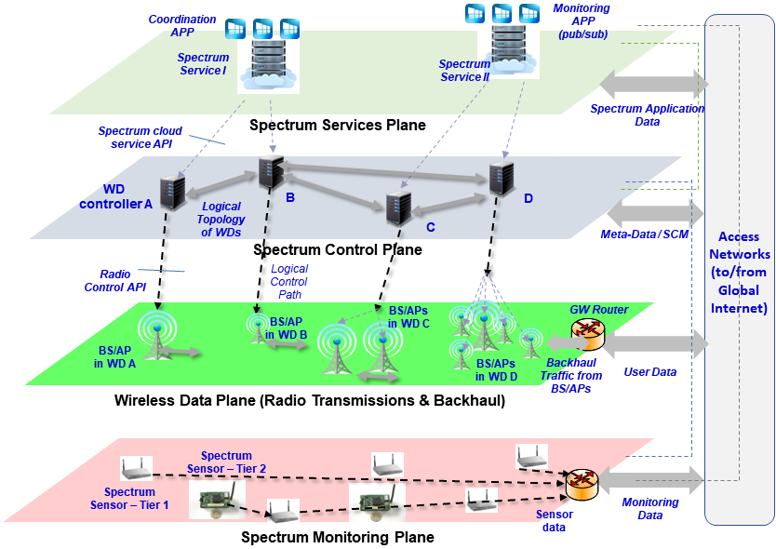
Architecture Diagram

Main Objectives

Collaboratively developing and experimentally validating methods to enable dynamic, fine-grained, and flexible spectrum interactions.

Co-Existence

Facilitating spectrum sharing and peaceful co-existence among heterogeneous devices and systems through distributed coordination.

Interference Management

Fine-grained management of interference, including aggregate interference effects, to support high spectrum efficiency and reuse.

Experimental Validation

Validating distributed deconfliction algorithms and policy languages using the COSMOS PAWR and NRDZ/ZMS testbeds.

Technical Approach: D3SM & SCMs

Based on IEEE 1900.5.2 Standards

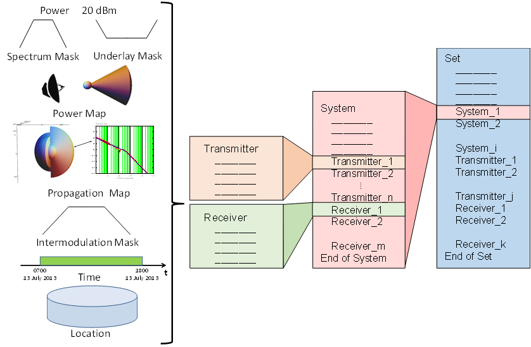
Spectrum Consumption Model

Spectrum Consumption Models (SCMs)

SCMs serve as the key information building block for our architecture. They provide a data model to capture all relevant parameters affecting spectrum consumption for any device.

  • Constructs: Transmitter, Receiver, and System Models.
  • Parameters: Reference power, Spectrum masks, Underlay masks, and Power maps.
  • Policy Integration: Using SCMs to define authorization sets, constraint sets, and configuration options.

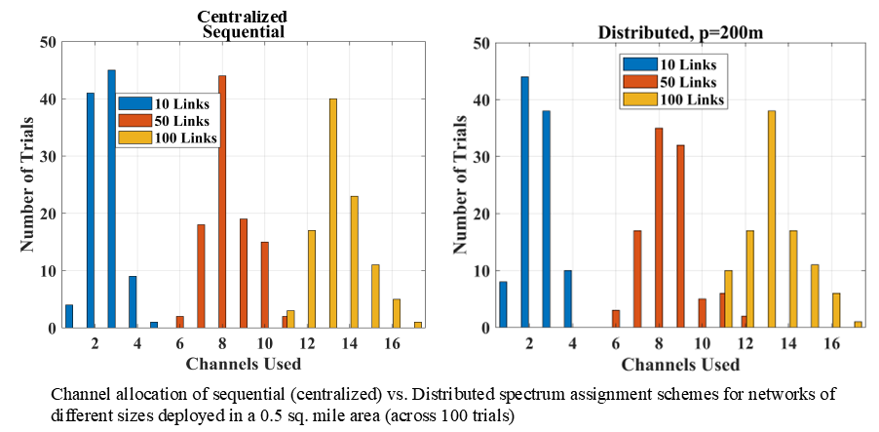
Distributed Deconfliction Results

Our ongoing work involves evaluating distributed spectrum use deconfliction algorithms. Preliminary results demonstrate that a distributed algorithm with a neighborhood distance of 200m can achieve a global compatibility error of 0%, matching the performance of centralized approaches.

*Simulated environments include ns3 mobility/propagation modeling and future implementations on O-RAN based setups.

Deconfliction Results

Project Leadership

A collaboration between Syracuse University and Rutgers University.

Carlos E. Caicedo Bastidas

Principal Investigator

Syracuse University

Ivan Seskar

Co-Principal Investigator

Rutgers University / WINLAB

Chief Technologist at WINLAB, Program Director for COSMOS, and PI for COSMOS³. Expert in experimental wireless systems.

Dipankar Raychaudhuri

Co-Principal Investigator

Rutgers University / WINLAB